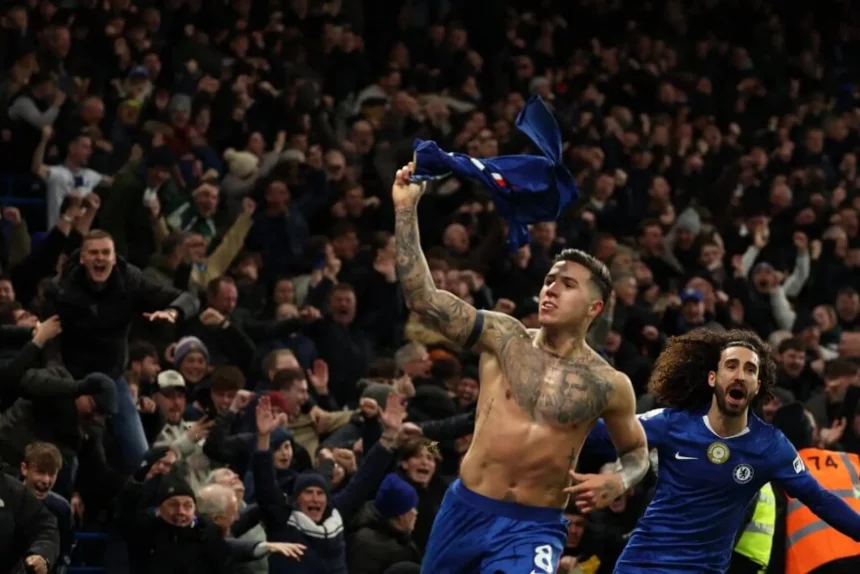
Enzo Fernandez waves his shirt above his head in celebration at his late winner Adrian Dennis/AFP via Getty Images
Liam Rosenior had already made a hugely encouraging start as Chelsea’s head coach. Now he and his side have made history.
Never before had this club come back to win from 2-0 down at half-time in a Premier League game and yet, in the disbelieving din of Stamford Bridge, Enzo Fernandez’s stoppage-time goal achieved that here.

A side who had been booed off at the break after a dreadful performance were revived by Rosenior’s changes, with the substitutes contributing two goals and two assists. West Ham United are in the bottom three but in the context of their initial dominance, this was a staggering Chelsea comeback.
The visitors had shredded their hosts down Chelsea’s left side throughout a one-sided first half to establish an impressive lead. There was some fortune to West Ham’s opener as Jarrod Bowen’s delivery drifted over the mess of bodies in the penalty area and beyond a startled Robert Sanchez, but that merely set the tone. Crysencio Summerville, connecting sweetly with Aaron Wan-Bissaka’s centre, thumped in a deserved second nine minutes from the break.
A trio of half-time changes saw Rosenior completely revamp his team’s left flank, with two of the substitutes combining to halve the deficit as Joao Pedro headed home Wesley Fofana’s cross and wrested back the impetus. Parity, which had felt so distant at half-time, was secured as another substitute, Marc Cucurella, dived to nod in an equaliser after the ball bounced down off the crossbar.
The winner was dispatched by Fernandez, with West Ham’s frustrations boiling over into a melee at the end. Jean-Clair Todibo, who had hit the post at 2-2, was sent off after a VAR review for grabbing Joao Pedro around the throat. Chelsea celebrated an unlikely victory seconds later, moving up to fourth in the table.
Here, Cerys Jones and Liam Twomey dissect the key talking points from a frantic occasion at Stamford Bridge.
Where was Chelsea’s left flank in the first half?
West Ham’s second goal was the inevitable result of how vulnerable Chelsea’s left side had looked throughout the first half.
Summerville was given too much space to summon his smart finish, but the worst of the defending had come in the build-up. After Bowen brought down a long ball, Jorrel Hato allowed him too much time to pick out the underlapping Wan-Bissaka, whom Alejandro Garnacho had completely failed to track.
Benoit Badiashile rushed across to prevent Wan-Bissaka from having a clear shot at the near post, but instead the West Ham right-back calmly pulled his centre towards Summerville by the penalty spot to thrust the visitors 2-0 up.
It was poor defending, and to make matters worse, Wan-Bissaka had the beating of Garnacho across the pitch.

Aaron Wan-Bissaka challenges Alejandro Garnacho, a feature of the first halfDarren Walsh/Chelsea FC via Getty Images
The Argentinian was frequently forced to turn backwards, so reluctant was he to take on his former Manchester United team-mate, and was tracked diligently. He struggled to link up with Hato, who was tasked with Cucurella’s usual role ‘inverting’ into midfield, and the whole left side appeared disjointed and tepid.
At the half-time whistle, 56 per cent of West Ham’s attacks had come down their right third of the pitch — a remarkable statistic, highlighting the fragility they sensed on that side. It was unsurprising that Hato and Garnacho were withdrawn at half-time for Cucurella and Joao Pedro.
Cole Palmer was shuffled out wide to make room for Joao Pedro in the centre behind Liam Delap, but the hosts began the second half with a new left side, hoping to restore some order.

Did Rosenior make too many changes to his starting XI?
Chelsea’s rotation policy was never expected to change under their new head coach, but this is the first time it has really drawn attention since Rosenior took charge. There were seven changes from the side that pulled off Wednesday’s victory over Napoli, and it left Chelsea looking disjointed.
Three of the back four were replaced, leaving a defensive line that had never played together. Malo Gusto was the only remaining member of the defence from midweek, but he lacked any rapport with Jamie Gittens, who was playing on the right rather than on his preferred left flank.

Cole Palmer and his Chelsea team-mates played like strangers in the first halfJustin Setterfield/Getty Images
Moises Caicedo and Fernandez in Chelsea’s midfield provided a little stability, but wingers Garnacho and Gittens, who had not started either of Chelsea’s past two games, looked low on conviction and provided little outlet.

In the first half, there was a real lack of understanding between Chelsea’s players. Those who came in with a case to make for more starting minutes looked nervous.

Jarrod Bowen’s cross flies beyond a diving Robert SanchezAdrian Dennis/AFP via Getty Images
Chelsea’s determination to manage minutes carefully is a decision above the head coach and the policy will not change. Wanting to rest Joao Pedro, Cucurella and Reece James is understandable — but perhaps more needs to be done to build the confidence of Gittens, Hato and other squad players. That might involve bringing them on for longer substitute appearances when the pressure is lower than a starting berth in a London derby.
Otherwise, the risk of a notable drop-off is high.
So how did they turn it around?
The atmosphere inside Stamford Bridge at half-time was Rosenior’s first real taste of the Chelsea faithful’s unhappiness.
His side had produced an unimaginative and meek first half, and he did not hesitate to perform major surgery, replacing Hato, Garnacho and Badisahile with Wesley Fofana, Joao Pedro, and Cucurella at the break. The confidence of the three substitutes duly turned the match on its head.

It was difficult to picture Badiashile driving forward to float in a superb cross for Joao Pedro’s opener as Fofana did, or Hato crashing the box to head home as Cucurella did to score the equaliser. Joao Pedro carried the unmistakable air of a forward in form: he was constantly in motion and calling for the ball, which in turn helped take attention away from Liam Delap.
It was also his vision, despite a shot at goal in front of him and cries to shoot from the stands, that picked out an excellent cross for Fernandez to hammer in Chelsea’s winner.

Joao Pedro claps hands with Liam DelapChris Lee – Chelsea FC/Chelsea FC via Getty Images
Rosenior deserves huge credit for inspiring this revival. But it does prompt the football equivalent of the chicken-and-egg problem: were the substitutions inspired, or was the initial selection flawed?
Against a stronger team than West Ham, Chelsea might not have managed to salvage anything from this game. A quieter schedule for a little while, with Chelsea spared from competing in the Champions League play-offs, may mean Rosenior does not have to walk such a careful tightrope with his selection.
Should Chelsea expect more from their wingers?
This was the week in which Rosenior clarified Chelsea’s wing pecking order beyond all doubt.
Despite both nominally preferring to operate from the right flank, Pedro Neto and Estevao were the two wingers picked to start against Napoli — the game that could secure automatic passage to the Champions League round of 16 and, therefore, the clear organisational priority.
When the moment came for rotation against West Ham, Garnacho and Gittens got their chance. Rosenior’s selection was partly conditioned by Estevao being granted permission to return home to Brazil for personal reasons, but the logic of Chelsea’s squad build is that two attackers signed last summer for a combined outlay of almost £90million ($123m) should be able to thrive in assignments like this.
Instead, Garnacho and Gittens merely reinforced their status as backups.

Jamie Gittens hobbles away from the contestJustin Setterfield/Getty Images
That is a little harsher on Gittens, who lasted just 26 minutes before succumbing to a muscle injury, but until that moment, his contribution was in line with an underwhelming start to his Chelsea career.
On the left, Garnacho’s 45-minute shift was a disaster. Wan-Bissaka dominated him at both ends of the pitch, with Garnacho’s defensive inattentiveness becoming a huge issue. Gittens should improve once he recovers his fitness, but the first half against West Ham underlined the broader reality that, despite all the player churn and transfer outlay, Chelsea are still getting nowhere near enough production from their wingers.

Pedro Neto came on for the injured Jamie GittensDarren Walsh/Chelsea FC via Getty Images
Neto, often held up as the best of the bunch, has just seven goals and four assists in 34 appearances across all competitions this season — not noticeably better than Raheem Sterling’s record before he was rendered obsolete by the Portuguese’s arrival from Wolverhampton Wanderers in 2024.
Four of Garnacho’s six goals have been scored in the Carabao Cup, and Gittens’ bottom-line numbers are negligible. Estevao is by far the most talented and the biggest cause for hope, but it is unreasonable to expect an 18-year-old so early in his Premier League career to be more than a moments player.
That is a big problem when so much of Chelsea’s football relies on getting the ball to wingers who can create advantages one-versus-one, for themselves or for others.
Step forward Enzo
Who needs goalscoring wingers when you have a penalty-area crashing midfielder like Fernandez?
There were flashes of this player under Mauricio Pochettino, and his role as a ‘pocket’ player was formalised under Enzo Maresca. Rosenior has clearly recognised a good thing happening and Fernandez’s dramatic winner against West Ham was his sixth in his last 10 appearances.

Enzo Fernandez and Chelsea celebrate their win in the bedlam (Adrian Dennis/AFP via Getty Images
Not all have come in open play, but Fernandez’s instincts for when to arrive in the opposition penalty area are only matched by his ability to find the right finish when he gets there. It was no great shock when he was the man to connect with Joao Pedro’s deft cutback and complete Chelsea’s comeback win.
This is not exactly the role that Fernandez performed for Argentina during their triumphant 2022 World Cup campaign, which helped persuade Chelsea to sign him. But after a rollercoaster first three years of his Stamford Bridge career, his ability to focus his game on the final third is justifying his nine-figure price tag.
What did Rosenior say?
Speaking to Sky Sports after the game, the Chelsea head coach described how he tried to keep cool when Chelsea went 2-0 down. “I trust my group,” Rosenior said. “But the first-half performance was nowhere near the level in application or energy. But I stayed really calm. I said we could turn what probably feels like the worst day of our season into the best day of our season. And the players were magnificent in the second half.
“I’m learning about this group very, very quickly. With the three who came off, it wasn’t about their individual performances. I just felt, as a team, our functionality wasn’t there in the first half. You can see the fight and energy in the group, and the belief they have.
“There was no screaming or shouting at half-time. I changed the shape and we played more of a 4-4-2, old school, and it was more about how we win the second half. I didn’t have time to talk about the first half. It was about how we’d play and how we’d get back into the game.
“I just loved the energy in the stadium. That’s what Chelsea is all about. We showed in the second half all the things we wanted to see.”
What next for Chelsea?
Tuesday, February 3: Arsenal (Away), Carabao Cup semi-final second leg, 8pm UK, 3pm ET
Stay ahead with the latest updates!
Join The Podium Media on WhatsApp for real-time news alerts, breaking stories, and exclusive content delivered straight to your phone. Don’t miss a headline — subscribe now!
Chat with Us on WhatsApp