


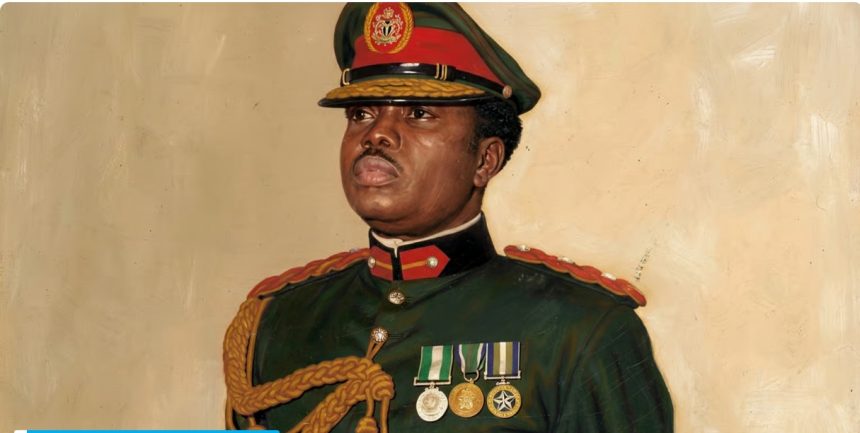
It is indeed a time to celebrate with Abuja and a group of seven states Hurricane Murtala Muhammed who spent barely six months in office created 50 years ago.
They will all clock 50 years on Tuesday February 3, 2026. It is also a time to reflect on the consequences of that political choice of creating seven more states (Benue, Bauchi, Borno, Imo, Oyo, Ondo and Ogun,) that joined the then General Gowon’s twelve states.
It is worth recalling to younger people who never experienced first-hand the consequences of military rule that before the seven states’ creation and proclamation of Abuja as the Federal Capital, the then Head of State organised a consequential purge of the federal civil service and its scars are still in the ruins of the federal and state bureaucracy till the present.
The noisy purge by General Muhammed was in 1975. According to the military head of state, the exercise was aimed at removing corruption, inefficiency, and indiscipline in the civil service. About 10,000 civil servants were arbitrarily sacked. The cleansing hit the civil service hard as many senior and experienced civil and public servants lost their jobs suddenly without any forms of backup. Those who survived became more careful: they began to save for the rainy day, even through side hustles, and building networks of enterprises to avoid future shocks. That advent of insecurity pushed some to corruption as they sought alternative income to survive the uncertainty that has since pervaded the once efficient and effective civil service.
Some of the major civil servants consumed by the 1975 bombshell included top permanent secretaries such as Allison Ayida, Philip Asiodu, Ime Ebong, Ibrahim Damcida, and Ahmed Joda, among others.
The about 10,000 civil servants purged affected judicial officers, diplomats, police, and public corporations’ officials, who were dismissed abruptly for reasons cited as corruption and incompetence. Other key bureaucrats retired included Alhaji SuleKatagum (Chairman of the then Federal Public Service Commission), Alhaji AbubakarTatariAlli, Mr F.M.C. Obi, Chief J.A. Adeyeye, and many more.
The case of Sir Samuel Layinka Ayodeji Manuwa—surgeon extraordinaire, Inspector General of Medical Services, and former Chief Medical Director to the Federal Government of Nigeria—was too tragic to be deconstructed. The sad highlight of the story was that on September 27, 1975, Dr. Manuwa who hailed from Ilaje in old Western State was unceremoniously booted out from office and given only two weeks to make his way out of his Ikoyi Government apartment. He died miserably in Surulere, Lagos six months after the sack.

Judges were not left out of the severe purge: Dr.Taslim Olawale Elias, Chief Justice of the Federation, Justice Adewale Thompson, Justice Ebenezer Ayoola, Justice O. Odumosu, Justice F.A. Abina, and others were affected. Other civil and public servants included: Alhaji Adamu Atta (Secretary to NEPA), Dr. Clement Isong, Governor of the Central Bank of Nigeria was also shown the way out.
In the academia, Professor Horatio Oritsejolomi Thomas, Nigeria’s first indigenous professor of surgery, was unceremoniously booted from office as the Vice Chancellor of the University of Ibadan. His dismissal came over a national radio newscast while he was hosting the luncheon for guests including some global figures who had attended the year’s convocation at the University of Ibadan. There were more victims.
The origin of the G-7 states and Abuja
The Head-of-State and Commander-in-Chief, General Murtala Muhammed had on August 7, 1975 set up a Panel to study the possibility of creation of mores states and the Panel was asked to come out with recommendations. Honorable Justice Ayo Irekefe, a Justice of Supreme Court was head of the Panel.
Justice Ayo Irekefe, who hailed from today’s Delta state was said to be used to handling tough jobs as he was Chairman of the Midwest Armed Robbery and Firearms Tribunal from 1970-1972.Other members are:
1. Mr Solomon Lar: Then a legal practitioner based in Jos, he later became the Governor of Plateau State and the 1st Chairman of PDP in 1999.
2. Brigadier Godwin Ally: Commander of the Lagos Garrison, he was a civil war commander in the 3rd Marine Commando.
3. Dr.Danlami Yahaya: was a 33-year old lecturer at the Bayero University at the time.
4. Mr C. Audifferen: Then Map Reproduction Officer at the Federal Ministry of Works
Dr. Patrick Dele Cole from Abonema, Rivers state (Secretary of the panel, he was with the Cabinet Office, Lagos. He later became Managing Director of Daily Times and the Nigerian Ambassador to Brazil.
Based on the recommendation of this panel to the Murtala-led junta, some states were created, bringing the total number of states in Nigeria to 19.
1. Anambra 2. Bauchi 3. Bendel 4. Benue 5. Borno6. Cross River 7. Gongola
8. Imo 9. Kaduna 10. Kano 11. Kwara 12. Lagos 13. Niger 14. Ogun 15. Ondo16. Oyo 17. Plateau 18. Rivers 19. Sokoto.
A broadcast by General Mohammed proclaiming Abuja as Federal Capital Territory 50 years ago:
Fellow Nigerians,
A joint meeting of the Supreme Military Council and the National Council of States has just concluded sitting.
The meeting has declared on reports submitted by the following Panels, assets investigation of some former public officers, abandoned properties in the three Eastern States, which comprised the former Eastern Region, location of the Federal Capital and creation of more states.
Those panels, as you will no doubt recall, were set-up by this administration at its inception. They were all given adequate terms of
reference and sufficient time in which to deliberate and submit their reports and recommendation to the FMG.
I will like to seize this opportunity to thank each and every one of them for the excellent work they have done. They deserve the nation’s gratitude. In deliberation on these reports, I will like to emphasise that the joint meeting was guided solely by national interest and consideration for justice, peace and stability.
The panel on the location of the Federal Capital has recommended that the nation’s capital should move out of Lagos to a federal territory of about 8,000 square kilometres to the central part of the country. The Supreme Military Council has accepted this recommendation. The site recommended satisfied the Panel’s criteria of centrality good and tolerable climate, land availability, and use, inadequate water supply, low population density, physical planning convenience, security and multi-access possibility.
The area is not within the control of any of the major ethnic groups in the country. We believe that the new capital created on such virgin lands as suggested will be for all Nigerians a symbol of their oneness and unity. The Federal Territory will belong to all Nigerians.
The few local inhabitants in the area who need to be moved out of the territory for planning purposes will be resettled outside the area in places of their choice at government expense.
In order to avoid land speculation in the area, a decree is being promulgated immediately to vest all land in the Federal Territory in the Federal Government. A Federal Capital Development Authority is to be established to plan and administer the territory. An administrator for the Federal territory will soon be appointed to provide municipal services in the area.
The chairman of the Federal Government Authority of nine members will be of cabinet rank. The authority is expected to start work at once but the movement of the seat of the Federal Government out of Lagos is expected take some ten to fifteen years. The present administration is firmly committed to ensuring that the necessary groundwork is completed and construction work started within the next four years.
Lagos will, in the foreseeable future, remain the nation’s commercial capital and one of its nerve centres. But in terms of servicing the present infrastructure alone the committed amount of money and effort required will be such that Lagos State will not be ready to cope. It will even be unfair to expect the state to bear this heavy burden on it sown. It is therefore necessary for the Federal Government to continue to sustain the substantial investment in the area. The port facilities and other economic activities in the Lagos area have to be expanded. There is need in the circumstances for the Federal Government to maintain a special defence and security arrangement in Lagos, which will henceforth be designated a special area.
These arrangements will be carefully worked out and written into the new constitution. Kaduna and Port Harcourt are to be accorded similar status and designated special areas under the constitution.
February 3 in Nigeria’s History
On this day in 1976, Nigeria was geopolitically restructured.
In a broadcast that proclaimed the consequential rejig, General Muhammed announced a bold decision that would change the country’s political structure forever: Nigeria was expanded from 12 states to 19 states. This was more than just about boundaries on a map. It was said to be a response to years of agitation, imbalance, and the dominance of large regions. The aim was clear: bring governance closer to the people and give minorities a stronger voice. 50 years on, has agitation for more states stopped? Aren’t we still talking about imbalance? We are now 36 states and Abuja. Have states creation brought government closer to the people? Have minorities been given a stronger voice?
As we celebrate the achievements and big dreams of Murtala today, can we also hail the organic author of federal character principle to sleep well today wherever he is and praise the genius that we have defeated the dominance of large regions?
States like Ogun, Ondo, Imo, Bauchi, Benue, Niger, and Borno emerged from the restructuring at issue, laying the groundwork for the Nigeria we know today. Are the minorities in the seven states created 50 years ago happier as envisaged by the General?
What of General Muhammed’s promises to Lagos, Kaduna and Port Harcourt to be designated as Special Areas? The promises remain unfulfilled 50 years on.
It was a tragic denouement that General Muhammed was assassinated ten days after these monumental proclamations. On February 13, 1976 he fell to the treacherous bullets of his assassins.
Yet, this decision remains one of the most impactful reforms in Nigeria’s post-civil-war history a foundation upon which the current 36-state structure was later built. It is regretful that those who have been running Nigeria and its capital since February 14, 1976, have never deemed it fit to name any significant monument or roads in Abuja after its creator. Buhari’s Way, IBB Boulevard, Shagari Way, Abdusalami Abubakar Way, Olusegun Obasanjo Way, Tafawa Balewa Way, Umaru Yar’ Adua Way, Ernest Shonekan Road, Goodluck Jonathan Way, even M.K.O Abiola Way and Stadium, Obafemi Awolowo Road, Zik’s International Airport, Zik’s Ring Road, and then the longest and broadest, Ahmadu Bello Way. Can anyone show the nation where Murtala Muhammed Way is located in Abuja 50 years after he proclaimed Abuja as the nation’s capital?
Stay ahead with the latest updates!
Join The Podium Media on WhatsApp for real-time news alerts, breaking stories, and exclusive content delivered straight to your phone. Don’t miss a headline — subscribe now!
Chat with Us on WhatsApp