




Nigeria is entering a pivotal moment in its humanitarian response journey.
As one of eight transition countries in the global Humanitarian Reset, Nigeria faces a stark reality: humanitarian needs remain persistently high, while international funding continues to drastically shrink. This tension is forcing a necessary reckoning on how humanitarian assistance is delivered — and, more importantly, who leads it.
Nowhere is the challenge more visible than in north-east Nigeria. In Borno, Adamawa and Yobe states alone, an estimated 5.9 million people will require humanitarian assistance in 2026. Yet available resources fall far short of meeting this demand. The 2026 Humanitarian Needs and Response Plan seeks US$516 million, prioritising 2.5 million people in the most acute need of life-saving support — less than half of those who require humanitarian assistance.

These figures point to a simple truth: business as usual is no longer viable. The future of humanitarian action in Nigeria must be owned, led and sustained by Nigerian institutions and organisations, with international partners playing a supportive and enabling role.
This shift lies at the heart of the Humanitarian Reset — a collective commitment by global humanitarian actors to deliver faster, and more accountable assistance at a time when the system is overstretched and under-resourced. The Reset calls for a sharper focus on lifesaving priorities, more agile and context-specific delivery, stronger in-country leadership, deeper engagement with affected communities, and a renewed defense of humanitarian principles. At its core, it is both a reform agenda and a mindset shift: from control to collaboration, from competition to complementarity, and from caution to courage.
For Nigeria, this transition must begin with government leadership.
Federal and state authorities are closest to affected populations. They carry the constitutional responsibility to protect citizens and are best positioned to align humanitarian action with national priorities. A nationally led humanitarian model requires more than coordination; it demands increased domestic financing, and sustained investment in systems that help communities withstand future shocks. No humanitarian response can be durable if the government is not firmly in the driver’s seat.
Equally central to this transition are national organisations. Nigerian civil society and community-based organisations bring deep contextual knowledge, social legitimacy and long-term presence that international actors cannot replicate. In many hard-to-reach areas, they are the only responders with consistent access. Experience shows that when local organisations are trusted, adequately resourced and meaningfully included in decision-making, humanitarian responses become more efficient, more accountable and more relevant to community needs.
Localisation, therefore, is not a slogan or a concession. It is a practical and necessary pathway to sustaining impact in an era of declining external funding.
Encouragingly, this shift is already underway. The Nigeria Humanitarian Fund, managed by the UN Office for the Coordination of Humanitarian Affairs (OCHA), has steadily increased the proportion of funding channelled through national non-governmental organisations. In 2025, national NGOs received a record 70 per cent of direct allocations. Once considered peripheral actors, these organisations have strengthened financial controls, improved compliance systems, expanded technical expertise and demonstrated strong risk management. Women-led organisations, in particular, are emerging as critical humanitarian actors, shaping priorities and amplifying community voices that are too often marginalised. These gains illustrate what is possible when investment in local capacity is deliberate.
Yet localisation is about far more than funding flows.
It requires a fundamental shift in how partnerships are conceived and managed. Risk management must evolve from exclusion to shared responsibility. Technical support must move beyond project supervision towards genuine knowledge transfer and institutional strengthening. Over time, international humanitarian actors should step back from direct implementation and focus more on advisory roles, advocacy and resource mobilisation in support of national partners.
Local organisations, for their part, must be recognised as equal partners — not extensions of international agencies. They need predictable financing, better access to pooled funds and structured opportunities to influence humanitarian strategy.
Importantly, local civil society must also be empowered as agents of change. Sustainable progress depends on advocacy — changing political priorities, challenging harmful narratives and defending the rights of people affected by conflict and disaster. Affected communities should never be viewed as passive victims. They are people with dignity, agency and rights, and local organisations are best placed to champion those rights.
The transition of the humanitarian operation in Nigeria also demands stronger alignment between humanitarian and development efforts.
The Humanitarian Reset creates space for a more coherent approach in which emergency action focuses on saving lives, while development frameworks — including national plans and the UN Sustainable Development Cooperation Framework — address the structural drivers of vulnerability.

Insecurity, underdevelopment and climate risks require long term solutions.
Investments in food systems, basic services, disaster risk reduction and anticipatory action are essential to reducing humanitarian caseloads over time. Without these investments, emergency needs will continue to outpace available resources, perpetuating the cycle of crisis response.
As the 2026 Humanitarian Needs and Response Plan is launched, the message is unmistakable.
The era of internationally financed, internationally delivered humanitarian operations in Nigeria is drawing to a close. The next phase belongs to Nigeria itself. To the institutions that set policy, the state authorities that coordinate response, national organisations that know their communities best, and the citizens who have borne the greatest burden for far too long.

For the United Nations and its partners, the role is clear: support this transition. Strengthen capacity where needed. Reinforce partnerships at all levels. Mobilise resources alongside government. And ensure that people affected by crises remain firmly at the centre of every decision.
Ultimately, localisation is about dignity.
It is about recognising that communities must lead the solutions to the challenges they face.
Nigeria’s humanitarian future depends on embracing this shift fully and without hesitation. The opportunity is present. The responsibility is shared. And the time to act is now.
About the Authors
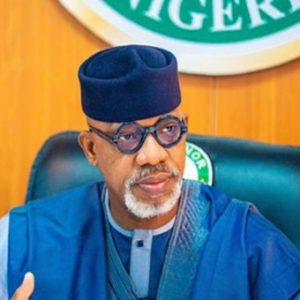
Dr. Bernard M. Doro is the Honourable Minister of Humanitarian Affairs and Poverty Reduction of the Federal Republic of Nigeria. He is a distinguished professional with over two decades of experience spanning clinical practice, law, pharmacy practice, management, leadership, and humanitarian development in Nigeria and the United Kingdom. He is widely recognised for his humanitarian work through the Doro Vision Platform and has been honoured with a Doctor of Humane Letters (DHL) for service to vulnerable communities.

Mr. Mohamed M. Malick Fall is the United Nations Resident and Humanitarian Coordinator in Nigeria, leading the UN’s countrywide support to government efforts on development, peacebuilding and humanitarian action. He has served in senior leadership roles across the UN system for more than three decades, with postings in West, East and Southern Africa, and Asia. His work focuses on strengthening national systems, advancing locally led responses and ensuring that vulnerable communities receive timely and accountable support.
Stay ahead with the latest updates!
Join The Podium Media on WhatsApp for real-time news alerts, breaking stories, and exclusive content delivered straight to your phone. Don’t miss a headline — subscribe now!
Chat with Us on WhatsApp