

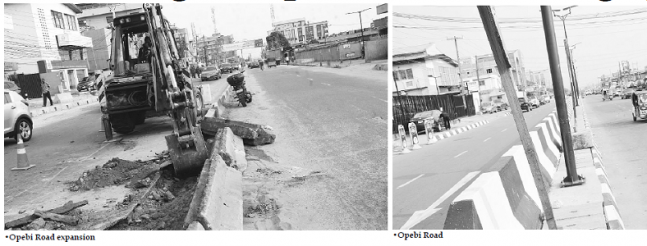
In Lagos, infrastructure is never just about concrete and steel; it is about time, survival and the fragile balance of daily life. Along the Opebi–Mende corridor, a bridge meant to restore movement has instead suspended routines, strained businesses and tested public patience. While government speaks of vision and transformation, those living and working beneath the rising structure continue to adapt, wait and hope — measuring progress not by design plans, but by when normalcy finally returns, reports ZAINAB OLUFEMI.
Some are hopeful, others exhausted, and many are quietly asking the same question: are we almost there, or are we still waiting? That question hangs in the air across parts of Ikej a and its surrounding corridors, where a major infrastructure project promised relief but has instead prolonged anticipation. Earlier, The Nation reported assurances from the Lagos State Commissioner for Information and Strategy, Mr. Gbenga Omotoso, who spoke confidently during an interactive session with members of the Lagos State Correspondents’ Chapel at Alausa, Ikeja.
“All the beautiful projects that we have embarked upon will be completed soon. The Opebi–Mende Link Bridge will be commissioned before the end of this year. What remains now are just finishing touches,” Omotoso said. He stressed that Governor Babajide Sanwo-Olu and his deputy, Dr. Obafemi Hamzat, operate a zero-tolerance policy for abandoned projects.
For many Lagosians, the assurance was reassuring. After years of navigating gridlocks around Opebi, Allen, Maryland and Ojota, the bridge represented far more than concrete and steel. It symbolised movement, relief, and the possibility of reclaiming countless hours lost daily to traffic congestion. The bridge promised an alternative route, a release valve for some of Ikeja’s most congested arteries.

But months later, the early excitement has given way to cautious waiting. A visit to the project corridor reveals a quieter, more complicated story—one of half-cleared roads, altered access points, and businesses learning to adapt amid dust, demolition and uncertainty. The bridge itself rises steadily, imposing and ambitious against the skyline. Yet its commissioning remains out of reach for commuters who had expected an open road by now, and for traders whose livelihoods have been reshaped by the prolonged construction phase.
Along Opebi Road, the impact of the road expansion tied to the bridge project is immediate and impossible to ignore. Entire sections have been reshaped, sidewalks narrowed or removed, and familiar landmarks altered. For businesses lining the corridor, the changes have been disruptive. At an MTN outlet on Opebi Road, Grace Samuel, a company representative, recalled how demolition associated with the expansion caught many off guard. “They told us they wanted to expand the road so that two vehicles can pass easily. At first, we didn’t really believe it would happen the way it did. Then one day, they just started demolishing from that side. They broke part of our office,” she said.
The demolition, she explained, disrupted long-standing parking arrangements and changed how customers accessed the office. What had once been a convenient stop became a logistical challenge. “Before, customers could park here. Now we have to park on the other side. That has affected convenience,” she said, adding that the company would have to bear the cost of renovating the damaged space.
Still, her frustration was tempered with optimism. Like many business owners along the corridor, she believes the long-term benefits will outweigh the short-term pain. “The road used to block traffic seriously. When it’s done, movement will be faster. We’re still coming back,” she said, expressing cautious faith in the project’s promise.
A few streets away, the impact is less dramatic but no less significant at Sooyah Bistro in Ikeja. Here, the disruption has translated into a quiet but steady loss of walk-in customers. Omotola, a staff member at the restaurant, said construction activities drastically reduced foot traffic, forcing the business to rethink how it operates. “Our walk-in customers have really reduced,” she said. “Most of our orders now come from Chowdeck, Glovo and WhatsApp. People can’t locate us easily anymore.” The challenge, she explained, goes beyond visibility. Parking has become a major deterrent. “Customers are afraid their cars might be towed, so they don’t want to park,” she said.
For small and medium-sized businesses that depend on spontaneous visits and easy access, these changes have been costly. Some have adjusted by shifting to delivery models, while others are simply enduring, hoping the end is near. For commuters, the experience is similarly mixed. Traffic diversions intended to ease construction have sometimes created new choke points, redistributing congestion rather than eliminating it. Drivers speak of longer detours, unfamiliar routes and the mental fatigue of daily uncertainty. Pedestrians navigate narrower walkways, often sharing space with vehicles in ways that feel unsafe.
Although the business received prior notice before demolition began, Omotola said the timing of the exercise proved particularly damaging. According to her, construction commenced at a period when many businesses traditionally record their highest sales. “It happened around December, which is our peak period. Sales dropped,” she said, noting that the disruption came at a time when foot traffic and customer demand should ordinarily have been strongest.
Despite the immediate losses, Omotola expressed cautious optimism that the inconvenience would eventually give way to long-term gains. She believes the road expansion, once completed, would improve access to the area and restore customer confidence. “The road expansion is a good idea. Once it’s completed, movement will be better and we expect more customers,” she added.
For roadside traders operating outside formal shop structures, however, the hardship has been far more severe. Many of them lack the buffer or flexibility to absorb prolonged disruptions, making them particularly vulnerable to infrastructure projects of this scale. A food vendor, who requested anonymity, said her sales dropped sharply almost immediately after construction began. As access routes disappeared and the environment deteriorated, customers stopped coming. “Immediately they started the road, customers stopped coming,” she said. “There was nowhere to pass. Everywhere was dirty, especially during the rainy season.”Related News
Unlike shop owners who received advance notice, she said many roadside traders were caught unprepared. “That day was very stressful. We had already cooked. We had to pack food inside quickly while everywhere was dusty,” she recalled. Beyond the economic impact, the vendor said the construction has created serious health and safety concerns. Dust, debris, and exposed gutters now surround their trading spaces, posing risks to both vendors and customers, particularly those selling food.
“It’s not safe now,” she said. “But when they finish the road, especially this gutter, things will be better. Rats and dirt won’t disturb us again.” Her words reflect a recurring theme along the construction corridor: hardship tempered by hope. While daily survival has become more difficult, many traders continue to endure, clinging to the belief that the completed project will ultimately improve their working environment.
Despite the financial losses and health concerns, the vendor said she remains hopeful that the authorities will accelerate work and bring the project to a close. “I pray they finish it before the next rainy season,” she said. For many informal traders like her, the completion of the road is not just about better traffic flow. It represents the chance to rebuild livelihoods disrupted by months of uncertainty and to return to safer, cleaner conditions where business can once again thrive.
Government urges patience as landmark bridge nears completion

On the government’s side, officials insist that the ambition of the Opebi–Mende Link Bridge goes far beyond what is immediately visible on the ground. They argue that the project is not merely about easing traffic at a single corridor, but about delivering a long-term solution to some of Lagos’ most persistent mobility challenges. When contacted, the Director of Public Affairs at the Lagos State Ministry of Works, Mr. Sina Odunuga, was measured in his comments, offering few operational details but firm assurances about the project’s broader intent.
According to him, the bridge was conceived as a transformational piece of infrastructure designed to address long-standing congestion issues while reshaping movement patterns across key parts of Ikeja and its adjoining districts. “The project will solve major traffic problems,” Odunuga said. “Transformation itself is progress. What you are seeing there, the vision is higher than what you see. The concept of the project is bigger than that.”
In his view, the scale and symbolism of the bridge place it in the same category as some of Lagos State’s most iconic infrastructure developments. He likened it to the Ikoyi Link Bridge, which has since become both a functional transport artery and a visual landmark. “It is something like the Ikoyi Link Bridge. That’s how it’s supposed to look,” he said, suggesting that the Opebi–Mende project is intended to stand not only as a traffic solution but also as a statement of urban ambition.
Odunuga added that the project was initiated by the current administration and would be completed under the same leadership, an assertion aimed at addressing public concerns about abandoned or prolonged infrastructure works. He said the government remains conscious of the need to balance transparency with responsible communication, especially on projects that directly affect daily life. “We are very careful not to give out too much information as regards the road,” he said, noting that premature timelines can sometimes raise expectations that are difficult to meet, particularly when construction is influenced by weather, logistics, and technical complexities.

On the question of commissioning, Odunuga acknowledged the public’s impatience but stopped short of committing to a specific date. However, he was emphatic that the wait would not stretch indefinitely. “If it does not get commissioned this year, it will be within the first quarter of next year,” he said.
For residents and commuters, the bridge has gradually become a familiar Lagos narrative — one defined by bold vision, daily inconvenience, and patient hope. It mirrors the trajectory of many large infrastructure projects in the city, where the promise of future relief often competes with the reality of present disruption. Motorists navigating the surrounding corridors continue to endure detours, narrowed roads and unpredictable traffic patterns. Business owners along the route grapple with reduced foot traffic and accessibility challenges, while pedestrians adapt to altered walkways and safety concerns. Yet amid the frustration, there is a shared understanding that Lagos’ growth demands difficult choices and temporary sacrifice.
Urban planners and transport analysts note that projects of this scale rarely deliver immediate gratification. Their value, they argue, becomes evident over time — in reduced travel hours, improved connectivity, and the gradual easing of pressure on overburdened road networks. In that context, the true test of the Opebi–Mende Link Bridge will come not at its commissioning ceremony, but in the months that follow, as commuters begin to experience tangible improvements in their daily journeys.
Ultimately, the success of the bridge will be measured not by press statements or architectural ambition, but by how effectively it restores time, movement and dignity to everyday life in one of Nigeria’s busiest urban centres. Until then, the Opebi–Mende Link Bridge stands as both a symbol of promise and a reminder of delay — rising steadily above the road, visible proof of an unfolding vision, while those below continue to wait for the relief they were told was just around the corner.
Stay ahead with the latest updates!
Join The Podium Media on WhatsApp for real-time news alerts, breaking stories, and exclusive content delivered straight to your phone. Don’t miss a headline — subscribe now!
Chat with Us on WhatsApp