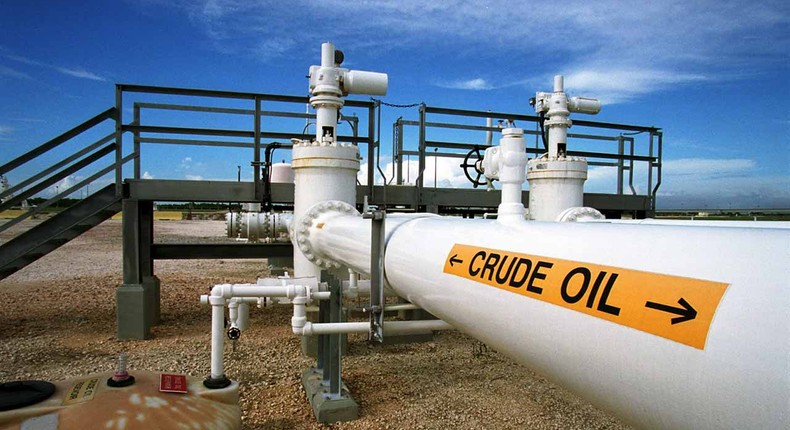
Nigeria has solidified its position as the leading African supplier of crude oil to the United States, exporting $2.42 billion worth of crude between January and August 2025.
Nigeria has tightened its grip as the United States’ largest African crude supplier in 2025, exporting $2.57 billion worth of oil between January and August
According to U.S. Census Bureau data, the West African nation accounted for more than half of all African crude imported by the U.S. during this period, shipping 33.23 million barrels out of a total 60.75 million barrels accounting for 55% of all African crude imports into the U.S. this year

Nigeria’s exports dwarf those of its continental peers, including Angola, Libya, and Ghana, underscoring its dominant role in transatlantic oil trade.
In practical terms, more than one in every two barrels of African oil unloaded at U.S. ports originated from Nigeria.
The gap between Nigeria and other African exporters remains wide.
Angola, Libya, Ghana and others contributed the remainder, but none came close to matching Nigeria’s volume.
Earlier-year figures told the same story: between January and May alone, Nigeria supplied 17.39 million barrels valued at $1.34 billion, representing 62% of all African crude purchased by U.S. refiners during that period.
Nigeria’s crude remains highly competitive
Nigeria’s dominance is underpinned by the continued attractiveness of its light-sweet crude grades, which are cost-effective to refine and meet U.S. environmental and processing standards.
In practical terms, more than one in every two barrels of African oil unloaded at U.S. ports originated from Nigeria. BI Africa
Long-standing commercial ties and shipping efficiencies also give Nigeria an edge over rivals whose production is more volatile or politically disrupted.
However, the landscape is expected to change as the 650,000-barrel-per-day Dangote Refinery scales up operations.
The facility, which is already Africa’s largest, has announced plans to expand its refining capacity from the current 650,000 barrels per day to 1.4 million barrels per day, potentially making it the largest single-site refinery globally.
As output ramps up, a significant portion of Nigeria’s crude will be diverted away from export markets and into domestic refining.
This shift could reduce Nigeria’s crude exports to the U.S. over time, although the immediate effect has been muted because the refinery is still stabilising operations.
In the medium term, the refinery is positioned to sharply cut Nigeria’s reliance on imported fuels, strengthen FX retention, and potentially increase the country’s export earnings through the sale of refined products rather than raw crude.

What it means for Nigeria
Despite the expected reconfiguration of crude flows, Nigeria’s 2025 export performance reveals its continued relevance in global markets.
Maintaining this lead, however, will depend on addressing production losses, improving security around pipelines, and ensuring consistent supply even as domestic refining capacity expands.
Stay ahead with the latest updates!
Join The Podium Media on WhatsApp for real-time news alerts, breaking stories, and exclusive content delivered straight to your phone. Don’t miss a headline — subscribe now!
Chat with Us on WhatsApp