


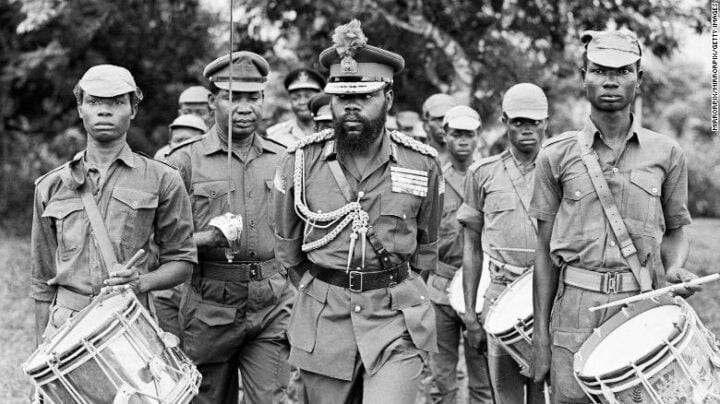
Chukwuemeka Ojukwu held discussions with fellow army officers to resolve the political face-off between Nnamdi Azikiwe and Abubakar Tafawa Balewa “in favour Azikiwe” in 1964, Yakubu Gowon, former head of state, has revealed in his memoir.
The book, ‘My Life of Duty and Allegiance’, published by the Havilah Group, was launched in Abuja on Tuesday.
BACKGROUND

Azikiwe, who was the ceremonial president of Nigeria from 1963 to 1966, had fallen out with Tafawa Balewa, the prime minister and head of government.
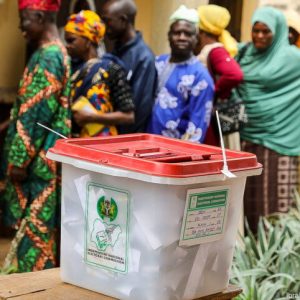
The tension between both men heightened ahead of the 1964 general election which was boycotted in parts of the country by Azikiwe’s party, the National Council of Nigerian Citizens (NCNC), and its allies over allegations of malpractices by the Northern Peoples Congress (NPC), Balewa’s ruling party.
Azikiwe initially refused to officially invite Balewa to form government after the disputed elections, causing a constitutional crisis as Nigeria did not have a head of government for 24 hours.
Azikiwe, as the commander-in-chief of the armed forces, tried to use the military to keep Balewa in check, but the British head of the army, Christopher Welby-Everard, a major general, received legal advice in favour of the prime minister.
Balewa then ordered the security agencies to place Azikiwe under house arrest.
But Azikiwe swiftly made the consequential call on Balewa to form government and then swore him in for a second term as prime minister.
OJUKWU’S SECRET MEETINGS
In his memoir, Gowon recounted the crisis, which happened when he was the adjunct general of the army while Ojukwu was the quartermaster general. Both of them were lieutenant-colonels.

He wrote: “I strayed into (Ojukwu’s) office while looking for Lt-Colonel David Ejoor the General Staff Officer 1 (GSO 1) on some urgent professional matters. Ejoor was not in his office or anywhere else that I could easily have found him. By chance, I went to check for him in the office of the Quartermaster General. Ejoor was there, as were Ojukwu who sat behind his desk and Colonel (Victor) Banjo. From their countenance and the way they sat, it was obvious they had been engaged in serious discussions before I walked into the office. Ojukwu first saw me and before I could say what brought me to his office – looking for the GO 1 – he said cheerily: ‘Oh, Jack, we’ve been looking for you, where have you been?’
“The way he said ‘we’ confirmed my guess that they had been discussing something topical. I told him I had been looking all around for Ejoor but could not find him until I chanced upon him in his (Ojukwu’s) office. He offered me a seat, but I chose to remain standing. I asked why he and the others needed to see me. Without beating about the bush, he said they had been reviewing the conflict between Dr. Nnamdi Azikiwe, the President and Alhaji Abubakar Tafawa Balewa, the Prime Minister and de facto head of government. This was no news to me or to anyone who had been following political developments in Nigeria at the time. It was common knowledge that the just concluded general elections of December 1964 had been deadlocked and neither Azikiwe nor Balewa was willing to yield an inch to the other in their political contest. The “Zik sacks Balewa” and “Balewa sacks Zik” scenario that ensued dominated the occasion.
“These two had a long history that was rooted in the race for the control of Nigeria by any of the three Regions in the country. Political historians have copiously documented the cause and course of how Zik and Balewa, who represented the East and the North respectively, could not make the alliance between their respective parties work. It did not matter much that their arch-rival, Chief Obafemi Awolowo (1909-1987) of the Western Region, was in prison in Calabar and, notionally, had severely limited political influence. But it is safe to say that the discussions, which I later gathered started between Ojukwu and Banjo, centred on seeking ways to intervene to break the logjam. This fact alone indicated the extent to which the relationship between Zik and Balewa had deteriorated. The two military officers (Ojukwu and Banjo) reasoned that if the military did not intervene, one way or the other, particularly in favouring Zik in the unfolding political drama, we might eventually be blamed for whatever happened to the young Nigeria.
“I paid a bit more attention to the argument Ojukwu marshalled. I had always known him to be politically savvy. The same, too, could be said of Banjo, whose high-level political sophistication coloured his perspectives, ruined his military career and eventually cost him his life in the hands of his compatriot, Ojukwu. Both men appeared too eager to join the political fray. Ejoor’s position was the one I could not situate in the political context, as it seemed that he had only been invited by the duo. This was when it struck me that something ominous was in the air. On a deeper reflection, it occurred to me that the basis of the invitation that Ojukwu had cheerfully extended to me was premised on the need to create the picture of a broad-based, ‘national’ military action that was supported by elements from the nation’s four Regions: Ojukwu from the East, Banjo from the West, Ejoor from the Mid-West and I from the North. The concurrence of a Northerner was needed to close the loop. To them, I represented the missing link of the jigsaw puzzle, hence the welcoming invitation to me to join in.
“From all indications, they had reviewed the issues at stake and had concluded that their interests, whatever these were, would be best served by military intervention on the side of the President so that Zik could take effective control of government. I did not feel comfortable with the subject of their discussion and strongly disagreed with their conclusion for the simple reason that both ran contrary to known military traditions, particularly in respect of the role of the military in society. I questioned their loyalty and military discipline. We were all trained to be officers in a disciplined Army that was loyal and supportive of the political leadership, that is, the government of the day irrespective of the political party in control. Certainly, we were not trained to be ambitious enough to try to supplant the will of the people.”

He said he believed the military needed to be loyal to the prime minister “who was the substantive Head of Government in the Parliamentary system that we operated. For me, therefore, any intervention on behalf of Zik, who we all respected but knew was a ceremonial President, was questionable because it would have amounted to a military-aided civilian take-over of government. Was this their intention or was it a camouflage for a military coup?”
Gowon said he told the three of them in Ojukwu’s office: “God helps anyone that starts any trouble.”
JANUARY 1966 COUP
The crisis from the elections, which culminated in deadly riots in the Western region, weakened the country’s democracy and some young officers eventually staged an unsuccessful coup in January 1966, killing Balewa; Ahmadu Bello, premier of the Northern region; Ladoke Akintola, premier of the Western region who was their political ally; and Festus Okotie-Eboh, minister of finance.

Zakariya Maimalari, a brigadier and the most senior military officer from the north, was also killed alongside many other northerners in the military.
The coup failed and Johnson Aguiyi-Ironsi, a major general and the new army chief, became the head of state.
His failure to prosecute the plotters, among whom were Kaduna Nzeogwu and Emmanuel Ifeajuna, was blamed for the counter coup of July 1966 and the killing of Igbos in northern Nigeria in retaliation for the January 1966 killings.
Gowon became head of state in July 1966 and Ojukwu eventually declared that the secession of the Republic of Biafra, with Banjo, Nzeogwu and Ifeajuna all on his side.
This led to a 30-month civil war that ended in 1970 when Biafra surrendered.
Gowon said in his book that northern officers believed Ojukwu was complicit in the January 1966 coup.

Stay ahead with the latest updates!
Join The Podium Media on WhatsApp for real-time news alerts, breaking stories, and exclusive content delivered straight to your phone. Don’t miss a headline — subscribe now!
Chat with Us on WhatsApp